Showing posts with label butterflies. Show all posts

Sunday, July 27, 2008

Beautiful Butterflies and Some Nature Journal Ideas


Showy Milkweed in Stoneman's Meadow, Yosemite Valley.

We did see some Monarchs fluttering and flying around the milkweed but there was never a chance to photograph one, maybe next time. :)

We were on the lookout for butterflies on our recent camping trip to Yosemite. Many were too fast or would not sit still long enough for a photo but here are a few that I can share. All these were butterflies that I saw as we went on various hikes in a variety of terrain and habitat. My daughter decided that she would rather take photos of flowers than insects because flowers stay in one place. :)

We know this is some sort of Fritillary but which exact one, we are not so confident. If I had to make a best guess, I think it is a Pacific Fritillary or a Western Meadow Fritillary.


Okay, there are two butterflies in this photo. It was taken in a marshy meadow area near Lukens Lake. There is one distinctly blue and one distinctly brown butterfly but I have no idea what particular ones they are even after examining the field guide for a long time. I'm not very good at identifying butterflies....yet.


Here is another blue butterfly sitting on some bird droppings. My best guess on this one is a Lupine Blue.


Now this one I think is a Woodland Skipper. I know it is a skipper for sure and it looks just like the one in my field guide.


You can see why I was able to take some good photos of these beauties, they were otherwise occupied with more important activities at that particular moment. I still haven't been able to identify this particular butterfly. Any ideas???

Here is one of my nature journal pages that I used to record one of my experiences with butterflies. I was testing out Tina's new notebooking pages that she is creating for an upcoming Outdoor Hour Challenge E-book that we are putting together to share with everyone. This page shows my attempt to record a bit about our butterfly study this past week.

Someone was asking recently about how I keep a running list in my nature journal. This is so easy to do and it doesn't need to be fancy. Tina has created an easy to use version of a running list that will also be in the upcoming E-book.

As you can see, I really just list the butterfly name if I know it and the date and place that I observed it. If I am not sure, I make a note and then use my photographs to identify it later when I have time to use the field guide and the internet.

So those are some of the butterflies that I was able to capture with my camera. We saw many, many Tiger swallowtails and a particular yellow butterfly that we have yet to identify. I look at this project as a life-long endeavor and if I don't catch the butterfly this time, maybe I will the next time.

Barb-Harmony Art Mom

Edit to add: Heather asked about my nature journal and how I plan on using the notebooking pages if I am using a spiral bound sketch diary as my nature journal. I made a decision to change to a bigger size nature journal, still spiral bound since I find that easiest to work in. I only have three pages left in my smaller spiral bound nature journal so I will be starting over in a 9" by 12" spiral bound artist's sketchbook that I purchased from Miller Pads and Paper. I will be attaching the pages into the sketchbook with double-backed tape; running lists will be in the back and the other sheets will go in order starting in the front. This will give me the flexibility to use the notebooking pages or to just freehand my entries in as I feel the need. I love to have options. This sketchbooks use heavy enough paper that I feel comfortable using watercolors in them as well as pencils and markers. Hope that explains it!

Tuesday, July 22, 2008

Chasing Butterflies -Outdoor Hour Challenge #22

You really need to click to enlarge this photo....look at the eye!

Today we went out to look for butterflies. We were optimistic. We persevered. We were rewarded.

I can't tell you how much it helps to focus on a particular aspect of nature as outlined in the Outdoor Hour Challenges. If you had asked me if there were butterflies in our backyard, I would have said a definite maybe. We see them from time to time fluttering in the garden but they move pretty fast and we don't get to spend a lot of time observing any one particular butterfly.....usually.

Today we sat out and watched and right away I saw a cabbage white skipping across the clover in the grass, not really sitting but flitting from blade to blade and then off he went. Next we saw what I think was a swallowtail of some sort. I am totally guessing and I say swallowtail because that is one type of butterfly we frequently have in our backyard. He was there and then he was gone way too fast. Then, after much sitting and focusing our eyes on the garden, we saw the best subject of the day. It was a fiery skipper. He sat on a bloom of the butterfly bush and we got to look at him closely. I went to get the camera. A few minutes later, he was back again and this time I was able to take the photo at the top of this entry. Fantastic!!!

The lesson of this blog entry. Pick your focus and be patient. I am ready and anxious to take some more time to go out with the boys and wait for butterflies.

Barb-Harmony Art Mom

Sunday, November 11, 2007

Swallowtail in the Garden

Western Swallowtail, Papilio rutulus
Handbook of Nature Study pages 301-304

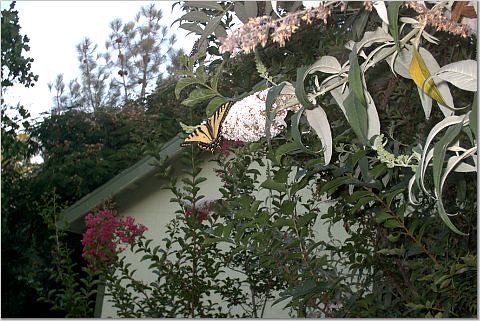
This is an old photo of a Western Tiger Swallowtail butterfly that we from time to time have in our garden. The size of this particular butterfly makes it an easy target to watch. We planted butterfly bush in our yard many years ago and have found that it attracts both butterflies and hummingbirds to our butterfly garden. We have a two purple ones and a white one.

Page 301
“This graceful butterfly is a very good friend to the flowers, being a most efficient pollen-carrier. It haunts the gardens and sips nectar from all the blossom cups held out for its refreshment; and it is found throughout almost all parts of the United States. The grace of its appearance ismuch enhanced by the “swallowtails,” two projections from the hind margins of the hind wings.”

Page 303
“The caterpillars of the swallowtail butterflies have scent organs near the head which they thrust forth when attacked, thus giving off a disagreeable odor which is nauseating to birds.”
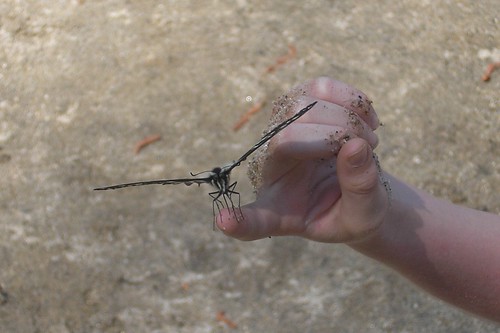
I just remembered that I had these photos from a trip to Yosemite this past summer of a swallowtail that made friends with my son. He even let him hold him on his finger.
Look at those legs? Amazing!

What a beautiful creature. I am always humbled by the simplicity and perfect symmetry found in our natural surroundings. Our God is a master Designer.


Barb-Harmony Art Mom

Thursday, November 1, 2007

Monarch Butterflies, Milkweed, and My Garden


Monarch on showy milkweed
Monarch Butterfly on Showy Milkweed-Yosemite National Park, Summer 2006

Last summer our family observed monarch butterflies among the milkweed at Yosemite National Park. There is a big meadow filled with milkweed within view of Half Dome. My interest in Monarch butterflies has grown from that experience and since we have a butterfly garden in our backyard, I began to think about adding some milkweed to the variety of plants we grow.

The Handbook of Nature Study talks about Monarch butterflies on pages 305-310 and page 309 has the observation questions for all three phases: butterfly, caterpillar, and chrysalis. I learned a lot from reading just those few pages and now I can refer back to them when we start to observe the life cycle of the Monarchs in our backyard habitat.

“This lesson may be given in September, while yet the caterpillars of the monarch may be found feeding upon milkweed, and while there are yet many specimens of this gorgeous butterfly to be seen. The caterpillars may be brought in on the food plant, and their habits and performances studied in the schoolroom; but care should be taken not to have the atmosphere too dry.”

Page 307
“The caterpillar will feed upon no plant except milkweed; it feeds both day and night, with intervals of rest and when resting hides beneath the leaf.”

“The monarch chrysalis is, I maintain, the most beautiful gem in Nature’s jewel casket; it is an oblong jewel of jade, darker at the upper end and shading to the most exquisite whitish green below; outlining this lower paler portion are shining flecks of gold. If we look at these gold flecks with a lens, we cannot but believe that they are bits of polished gold foil.”

I don’t have milkweed or monarch butterflies in my backyard. I did find a website that will send you milkweed plants to grow in your garden and in my ongoing development of a great butterfly garden, I am going to plant some milkweed. I am going to get some monarch caterpillars so we can start hatching them this spring and start an area that they will visit us in.

Here is the website:Live Monarch

I have been to Pacific Grove, CA and seen the monarchs in the monarch sanctuary where they winter up in the trees and it is quite a sight to see. The
Handbook of Nature Study has some great suggestions for studying these insects and I will keep you posted as our Monarch butterfly project progresses.

Barb -Harmony Art Mom