Since we have started our Green Hour Challenge, readers have been asking for field guide suggestions. I decided to put together a list of the main field guides that I use throughout the year. I have quite a collection but these are the ones we use the most. I am in California and most of my nature exploring is on the West Coast so obviously these will not be what you would use if you lived in the Midwest or on the East Coast. They will give you an idea of the series that I prefer and then you can look for versions that would fit your area of the world. I always check guides out at the library before purchasing them or I go into Borders and do a side-by-side comparison.
Hope this helps someone with their choices,
Barb-Harmony Art Mom
Field Guide Recommendations
West and Northwest
A little bit of everything for Western Forest
Western Forests by Stephen Whitney (Audubon Society Nature Guides)
ISBN 0394731271
On amazon.com used for 24 cents
Birds:
Field Guide to North American Birds-Western Region (Audubon Society)
ISBN 0394414101
On amazon.com used for 1 cent
Actual photographs of the birds.
Wildflowers:
Field Guide to North American Wildflowers-Western Region (Audubon Society)
ISBN 0394504313
On amazon.com used for 1 cent
Actual photographs of the wildflowers.
Trees:
Western Trees (Peterson Field Guide)
ISBN 0395904544
On amazon.com new for $13.60 and used for $7.70
Colored illustrations of trees, leaves, and cones.
Insects:
I have yet to find the "perfect" insect guide but this one comes close. I use it and get close to identifying the insect and then use the internet.
Field Guide to North American Insects and Spiders (Audubon Society)
ISBN 0394507630
On amazon.com new for $19.95 or used for $5.08
Actual photographs of insects and spiders.
For use on the Pacific Coast:
Pacific Coast Mammals by Ron Russo ISBN 0912550163
Tree Finder by May T. Watts ISBN 0912550015
Pacific Coast Fern Finder by Glenn Keator ISBN 0912559139
Showing posts with label field guides. Show all posts
Showing posts with label field guides. Show all posts
Thursday, May 1, 2008

Sunday, March 2, 2008
Signs of Mammals: Deer Scat

This really needs no explanation.
We are used to this sign of a mammal being in our yard and area by the tell-tale sign of his scat. The Mule deer, Odocoileus hemionus, is a familiar sight but still makes me stop and take notice. They are such gentle creatures and usually very shy.
A deer hit my car last year and made a dent in the driver's door and messed up my rear view mirror. He survived and I think he was a little mad at me. I was doing everything I could to avoid hitting him but he was actually trying to run up along side me and butt me with his head. It was a strange event and very memorable.
I can tell you from personal experience that Mule deer love rose blossoms and everything they can get their teeth on from my garden. We have put up a fence to keep them out of the garden but they still find things to munch on in our yard when they get hungry enough in the late summer.
I could not find any information in the Handbook of Nature Study but I do have a mammal field guide that shows an illustration, the scat, the tracks, and the look of the deer in various times of the season.
I love deer, just not in my garden or running alongside my car.
Barb-Harmony Art Mom
Sunday, February 24, 2008
Evening Grosbeak in My Feeder and How We Identify a Bird
 Very little compares to identifying a new bird in your feeder. This one was so unusual that we just couldn't stop looking at it.
The photo does not do it justice. It is bright yellow, with distinct markings of black and white. It was fairly good size so we got a pretty good look at it.
Although the photo didn't turn out well, the memory will be forever with us.
We identified this bird as an Evening Grosbeak.
(click photo for larger photo)
Yesterday we saw a bunch of blue birds that we had never seen before. We were out driving in the car when we saw nesting boxes all along a fence. We saw flashes of blue and realized that they were birds fighting, not only in the air but on the ground. The birds were very aggressive. When we got home we pulled out our field guide and identified the birds as Western bluebirds.
I shared the following information with a friend about how I identify a bird by explaining how I identified the Evening grosbeak. I personally like using the Audubon Society's Field Guide to Birds.
1. When I am trying to identify a bird, I rely heavily on color. The bird we saw in our feeder was a bright yellow so that narrowed it down as far as identifying it. The Audubon guide that I suggested for birds is organized by type of bird (clinging, perching, duck-like, etc) and then by predominant color. This makes it fast to skim through a lot of birds visually.
2. After I look at color and general type, I look at size. (sparrow-size, robin-sized, goose-size, etc) The Aububon guide does group from smallest to largest.
3. After color, type, and size, I look at beaks. This is really easy in the Aububon guide because on the photo pages there are three bird photos on a page so there are less pages to look through.
4. If I hit on the right bird by doing that method, I usually do a Google image search on the internet to confirm my findings. If I missed and didn't get the right bird but I am in the right ball park, I go to whatbird.com and do a search there.
That pretty much sums it up. I know that others have different methods for identifying birds with a field guide but this works for our family.
It was a big bird weekend around here. I love it.
Barb-Harmony Art Mom
Friday, January 11, 2008
Handbook of Nature Study: Friend or Foe?

My copy of the Handbook of Nature Study sat on my shelf for a couple of years and I finally sold it on ebay. Yes, you heard me right. I got tired of dusting it and feeling as if I should be doing something with it when I couldn't figure it out at all. So now you are wondering what happened to bring me around to where I am now. Simply put, I stopped fighting it.
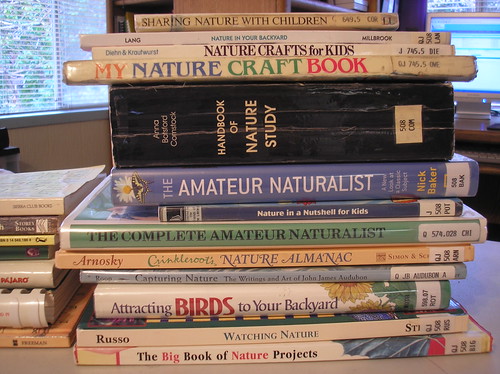
Maybe it was not the book that was the problem for us.
Since I trusted Ambleside Online's ideas for many subjects already, it was a natural fit to try their system for nature study. I went to their nature study page and read the whole thing. I then read the information in the Charlotte Mason volumes about outdoor time and nature study. I read other blogs that used the Handbook of Nature Study. In other words, I did a little bit of homework and came up with a plan for our family.
Tips from our experiences:
- Pick three sections of the book to cover in your school year....four if you want to cover one over the summer too. Try to think of things you will actually be able to observe in your course of everyday life. Do you have a birdfeeder? Do you have a pet cat or dog? Do you have a place to grow a few vegetables? Do you enjoy keeping track of the weather or looking at the clouds?
- Start with something you will enjoy.
- As the parent/guide, read the introduction to the section you are going to study a few times over. I have found that just reading these few pages opens your eyes to a lot of ideas for further study on the topic chosen. Use the information and suggested activities as a place to start your study of a particular animal or aspect of nature.
- Make notes in the book or in a notebook with ideas for your study.
- Go through your personal library and check for any reference items you may have on the subject of your study. I was surprised when I did this to find that I already owned quite a few books to go along with our fall study of insects. Check your library for books and field guides too.
- Our family enjoys identifying things we find on our nature outings. This means we need to have a basic field guide to go along with our study since the Handbook of Nature Study is NOT a field guide.
Barb-Harmony Art Mom
Subscribe to:
Posts (Atom)