Showing posts with label Fall term. Show all posts

Friday, November 30, 2007

Wrapping up our Fall Term Study of Insects

We have had several insects that we have seen and identified but not taken great photos of for the blog. One was an earwig that I found in my kitchen. I hate earwigs.

The Handbook of Nature Study does not have any information on the earwig but it is a great insect to identify the parts of an insect with. I knew what kind of insect it was so we did a quick internet search and found loads of information about it.

We also found a millipede which we quickly discovered was *not* an insect. It is an invertebrate. You can find an illustration of a millipede and a caption about it on pages 448-449 of HNS.


We also found a tarantula in our garage, dead and stiff. This made for some interesting observations. At first I was horrified by its appearance but then, after I knew it was dead, I was able to observe its parts and really see it up close. I don't care to do that too much but it was interesting this one time. :) So even though it technically isn't an insect, we did learn something about tarantulas.

Here's what the Handbook of Nature Study says on page 435-436:
"There is an impression abroad that all spiders are dangerous to handle. This is a mistake; the bite of any of our common spiders in not nearly so dangerous as the bite of a malaria-laden mosquito. Although there is a little venom injected into the wound by the bite of any spider, yet there are few species found in the United States whose bite is sufficiently venomous to be feared. With the exception of the tarantulas of the Southwest, and the hourglass or black widow, which seems now to be extending its range from the South, the spiders of the United States are really as harmless to handle as are most of our common insects."

Believe me, I will not be handling any tarantulas in the near future. :)

We are wrapping up the focus on insects and we will be moving on to mammals for now. I am sort of excited to start since I know we are going to learn so much about what has been under our very noses and we have missed it.

Barb-Harmony Art Mom

Monday, November 26, 2007

Paper Wasps-A Work of Art


You need to click on the photos to enlarge the photos and really see the wasp nest.

My dad found this paper wasp nest for us to look at in the tree behind his house. It is sooooo big I can hardly believe it. It does look like something has pulled it down and you can see the actual honeycomb cells that are exposed. Here is a better shot.

The texture of the nest itself is truly amazing. I found a resource online that says that they make the nest from a papery pulp of chewed up wood fibers mixed with saliva.

Page 378 of the Handbook of Nature Study has a lot of very interesting information about wasps in general.

Another great day out.

Barb-Harmony Art Mom

Crickets in the House


I have been busy trying to wrap up our fall study of insects. I never imagined we would enjoy finding and viewing insects as much as we did and I am sure part of it was the information provided in the Handbook of Nature Study. Anna Comstock provides such great investigations into the individual insects and we learned so much just by taking a few minutes each time we found a new insect to stop and really look at it. I think everyone in our family has gained a new appreciation for the little creatures we pass by so often.

Speaking of that topic, I had completely forgotten that we had our own personal laboratory in our house for studying a particular insect. Our Fire-Bellied toad eats crickets every morning and we keep a ready supply on hand but I had never thought to investigate them in the HNS. Sure enough, there on page 344 there is the start of a whole section on crickets. On page 346 there are instructions for making a "cricket cage". Pages 347 and 348 have observations questions for you to use with your cricket.

Here's something interesting from page 346:
"There would be no use of the cricket's playing his mandolin if there were not an appreciative ear to listen to his music. This ear is placed most conveniently in the tibia of the front leg, so that the crickets literally hear with their elbows, as do the katydids and the meadow grasshoppers. The ear is easily seen with the naked eye as a little white, disclike spot."

Our crickets don't make any noise so I don't know what that means. They are rather small and we purchase them at the feed store, 40 crickets for $2.00. They are much smaller than the local crickets we find in our yard. They are golden in color. I am going to ask at the feed store the next time we get crickets and see if they know what variety of crickets they are. Even though our particular cricket is not listed in the HNS, we can still read through the sections on black crickets and snowy tree crickets and apply the information to our crickets. See, I am learning to not use this big book as a field guide but as a way to familiarize us with general information about something we find in our nature study. :)

Barb-Harmony Art Mom

Thursday, November 22, 2007

Nature Walk in the Big Trees

Big Trees.......Sequoiadendron giganteum


It is really hard to get a good photo of the big trees and all your kids at the same time. It is rather dark underneath this forest canopy .


Fallen trees are great for walking on, or falling off of in my case. I was so busy trying too look at some cool fungus that I slipped totally off and fell down. Okay, everyone laughed but it wasn't too funny for me. :)


Seed cones from the sequoia tree are rather small.

Baby sequoias


A variety of fungus was all around at this time of year....too bad I didn't have a field guide. Oh well, next time.


That is just a sample of our day out today.

Barb-Harmony Art Mom

Sunday, November 18, 2007

Honeybee: Gardens that Help


In the latest issue of Organic Gardening, the cover article is all about bees. I had heard how honeybees had a bad winter last year and there are far fewer of them around but I hadn't taken the time to find out what it was all about. Interesting stuff. The article brings out that scientists estimate that "more than 30% of the nation's 2.4 million honeybee colonies died out over the fall and winter of 2006-2007" due to Colony Collapse Disorder. 35 states reported damage due to CCD. The damage was as high as 80-90 percent of their hives for some beekeepers.

What can we do to help the situation as home gardeners? The article brings out some easy steps that can make a difference. I always start planning my spring garden during the cold winter months so this article came at the right time and had lots of practical ways that I can plan my garden to benefit the local honeybee population.

Here are some ideas from Organic Gardening:
1. Plant flowers that are blue, purple, violet, white or yellow. The article suggests leaving the dandelions and Dutch clover in your lawn. Tip: Visit your local nursery and buy whatever you can find that has bees on it. My tip: Color and lots of it.

2. Skip flowers like marigolds and hollyhocks, impatiens, and salvia. The flowers are too dense for the bees to gather much nectar.

3. Try to plant for a three season bloom. The article says, "Spring is tough for bees. Common spring bulbs like tulips and daffodils aren't attractive to bees. It's good to have fruit trees or flowering shrubs to cover their early season needs." Some choices they list for spring are calendula and wild lilac. For fall they suggest sedum, asters, and goldenrod.

4. Bees stay longer in gardens at least 3 to 4 feet in diameter.

5. Bees need a water source.

The article was very enlightening and will help me plan my garden to include plants and flowers that can help my local honeybees. This is a great way to tie your study of insects into your gardening time. I am planning on keeping track of which plants have bees on them. I know they *love* my spanish lavender and I have it planted in two long rows along the edge of my garden. Even now in the middle of November it has many bees in it every afternoon. I have observed bees in my cosmos that are left in the back of the garden. The plant doesn't look as nice as it did in the middle of summer but the bees seem to enjoy it. My neighbor's rosemary plants are always full of bees so that might be a good plant to try too.

It may not seem like each individual garden can help but according to this article about bees, we can.

Barb-Harmony Art Mom
Thursday, November 15, 2007

Ladybug, Ladybug Fly Away Home!


Photo from last spring in my garden

How many times have you seen a ladybug? Do they make you smile like they do me? I have lots of memories of lady bugs from my growing up years and now in my own garden, I love to find them crawling around on my plants.

The Handbook of Nature Study has information on the ladybird (lady bug) on pages 364-366. On page 364 there are illustrations of the larva, pupa, and adult of the lady bug.

From the Handbook of Nature Study, page 366:
"The ladybird is a beetle. Its young are very different from the adult in appearance, and feed upon plant lice."

"These little beetles are very common in autumn and may be brought to the schoolroom and passed around in vials for the children to observe. Their larvae may be found on almost any plant infested with plant lice. Plant and all may be brought into the school room and the actions of the larvae noted by the pupils during recess."

Page 366 also has ten observations you can perform on either the adult or the larvae of the lady bug.

From page 365:
"From our standpoint the ladybird is of great value, for during the larval as well as adult stages, all species except one feed upon those insects which we are glad to be rid of."

"The ladybird is a clever little creature, even if it does look like a pill, and if you disturb it, it will fold up its legs and drop as if dead, playing possum in a most deceptive manner."

We enjoyed learning more about this common garden friend.

Barb-Harmony Art Mom


Sunday, November 11, 2007

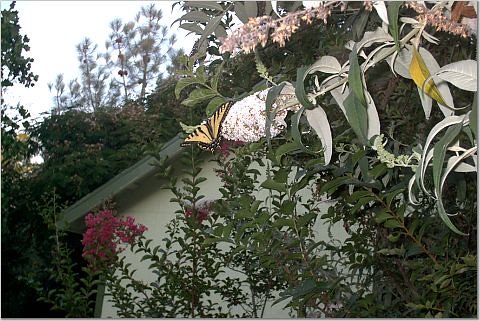
Swallowtail in the Garden

Western Swallowtail, Papilio rutulus
Handbook of Nature Study pages 301-304

This is an old photo of a Western Tiger Swallowtail butterfly that we from time to time have in our garden. The size of this particular butterfly makes it an easy target to watch. We planted butterfly bush in our yard many years ago and have found that it attracts both butterflies and hummingbirds to our butterfly garden. We have a two purple ones and a white one.

Page 301
“This graceful butterfly is a very good friend to the flowers, being a most efficient pollen-carrier. It haunts the gardens and sips nectar from all the blossom cups held out for its refreshment; and it is found throughout almost all parts of the United States. The grace of its appearance ismuch enhanced by the “swallowtails,” two projections from the hind margins of the hind wings.”

Page 303
“The caterpillars of the swallowtail butterflies have scent organs near the head which they thrust forth when attacked, thus giving off a disagreeable odor which is nauseating to birds.”
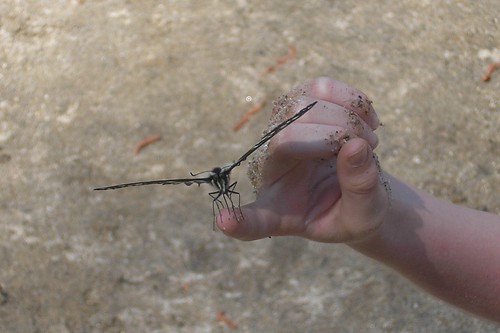
I just remembered that I had these photos from a trip to Yosemite this past summer of a swallowtail that made friends with my son. He even let him hold him on his finger.
Look at those legs? Amazing!

What a beautiful creature. I am always humbled by the simplicity and perfect symmetry found in our natural surroundings. Our God is a master Designer.


Barb-Harmony Art Mom

Thursday, November 1, 2007

More aphids-green this time


This day was a day of amazing proportions. I realized just how "big" an ant is to an aphid. Can you see the ant on the left and the two aphids on the right?

From the Handbook of Nature Study, page 353:
"Aphids have the mouth in the form of a sucking-tube which is thrust into the stems and leaves of plants; through it the plant juices are drawn for nourishment. Aphids are the source of honeydew of which ants are fond."


Page 353-354 also has eight activities to observe aphids in your nature study. Anna Botsford Comstock suggests observing a plant infested with aphids with a hand lens. We were delighted for a long time watching the ants and aphids on our rose bush.

You have to love this from the HNS, page 351.
"I know of no more diverting occupation than watching a colony of aphids through a lens. These insects are the most helpless and amiable little ninnies in the whole insect world; and they look the part, probably because their eyes, so large and wide apart, seem so innocent and wondering."

Here is an ant on the front of the rose leaf.....see the tiny little aphid on the leaf on the left? Amazing.

Barb-Harmony Art Mom

Monarch Butterflies, Milkweed, and My Garden


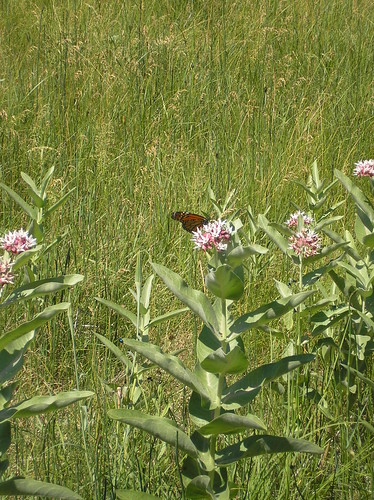
Monarch on showy milkweed
Monarch Butterfly on Showy Milkweed-Yosemite National Park, Summer 2006

Last summer our family observed monarch butterflies among the milkweed at Yosemite National Park. There is a big meadow filled with milkweed within view of Half Dome. My interest in Monarch butterflies has grown from that experience and since we have a butterfly garden in our backyard, I began to think about adding some milkweed to the variety of plants we grow.

The Handbook of Nature Study talks about Monarch butterflies on pages 305-310 and page 309 has the observation questions for all three phases: butterfly, caterpillar, and chrysalis. I learned a lot from reading just those few pages and now I can refer back to them when we start to observe the life cycle of the Monarchs in our backyard habitat.

“This lesson may be given in September, while yet the caterpillars of the monarch may be found feeding upon milkweed, and while there are yet many specimens of this gorgeous butterfly to be seen. The caterpillars may be brought in on the food plant, and their habits and performances studied in the schoolroom; but care should be taken not to have the atmosphere too dry.”

Page 307
“The caterpillar will feed upon no plant except milkweed; it feeds both day and night, with intervals of rest and when resting hides beneath the leaf.”

“The monarch chrysalis is, I maintain, the most beautiful gem in Nature’s jewel casket; it is an oblong jewel of jade, darker at the upper end and shading to the most exquisite whitish green below; outlining this lower paler portion are shining flecks of gold. If we look at these gold flecks with a lens, we cannot but believe that they are bits of polished gold foil.”

I don’t have milkweed or monarch butterflies in my backyard. I did find a website that will send you milkweed plants to grow in your garden and in my ongoing development of a great butterfly garden, I am going to plant some milkweed. I am going to get some monarch caterpillars so we can start hatching them this spring and start an area that they will visit us in.

Here is the website:Live Monarch

I have been to Pacific Grove, CA and seen the monarchs in the monarch sanctuary where they winter up in the trees and it is quite a sight to see. The
Handbook of Nature Study has some great suggestions for studying these insects and I will keep you posted as our Monarch butterfly project progresses.

Barb -Harmony Art Mom

Wednesday, October 31, 2007

Ants, Ants, Ants


So often I overlook the ants in my life....they seem to be everywhere. These ants were busy inside the rotting pear under our tree.

From page 372 of the Handbook of Nature Study:
"However aimless to us may seem the course of the ant as we see her running about, undoubtedly if we understood her well enough, we should find that there is rational ant sense in her performances. Therefore, when ever we are walking and have time, let us make careful observations as to the actions of the ants which we may see."

Page 372-373 of the Handbook has 14 different activities to use when observing ants.

I think we will be studying ants again with our ant farm in the near future. I had not realized that the HNS had so much information about ants and their nests.

Barb-Harmony Art Mom


Tuesday, October 30, 2007

Mosquito Eater, Or Is It?


Okay so we usually call these guys "mosquito eaters". It is actually a crane fly or scientific name: Tipula paludosa.

They look like giant mosquitoes and this one found its way into my son's workshop. He sat very still while I took a few photos and then with the magic of cropping, it really shows what he looks like.

This is from Wikipedia:
"
Numerous other common names have been applied to the crane fly, many of them more or less regional, including, mosquito hawks, mosquito eaters (or skeeter eaters), gallinippers, gollywhoppers, and jimmy spinners."

I was visiting my dad last week and we had a conversation that went something like this:
"Dad, you know those bugs we call mosquito eaters?"
"Yep."
"Well, I just learned that they are actually called crane flies."
"What?"
"You know those big flying bugs we see in the house, they are really big flies and they don't eat mosquitoes at all."
"Mosquito eaters, they are mosquito eaters."

Oh well, he can call them mosquito eaters. :)


More information from UC Davis' website:
"Adult crane flies emerge from the soil beneath turfgrass, pastures and other grassy areas in late summer and fall. The adults have very long legs and resemble large mosquitoes. Females mate and lay eggs in grass within 24 hours of emerging. Eggs hatch into small, brown, wormlike larvae that have very tough skin and are commonly referred to as "leatherjackets". The leatherjackets feed on the roots and crowns of clover and grass plants during the fall. They spend the winter as larvae in the soil; when the weather warms in spring, they resume feeding. During the day larvae mostly stay underground, but on damp, warm nights they come to the surface to feed on the aboveground parts of many plants. When mature, the larvae are about 1 to 1-1/2 inch long. Around mid-May they enter a nonfeeding pupal stage and remain just below the soil surface. In late summer, pupae wriggle to the surface and the adults emerge. There is one generation a year."


Barb-Harmony Art Mom

Sunday, October 28, 2007

Katydid or Grasshopper?


This little critter has been hard for us to identify. We found him and put him in our magnifying jar so we could take a really good look at him. I have never paid much attention to the differences between katydids and grasshoppers but now after identifying this guy, I know so much more about it.

This is what is called a Chapparal Katydid.


From the Handbook of Nature Study, page 343:
"I love to hear thine earnest voice
Wherever thou are hid,
Thou testy little dogmatist,
Thou pretty katydid,
Thou mindest me of gentle folks,
Old gentle folks are they,
Thou say'st an undisputed thing
In such a solemn way." -Holmes

From page 344:
"The katydids resemble the long-horned grasshoppers and the crickets. They live in trees, and the male sings "katy did" by means of a musical instrument similar to that of the cricket."

There is lots more information about katydids in the Handbook of Nature Study on pages 343-344.

Barb-Harmony Art Mom


Here is a little graphic my son made on the computer showing complete metamorphosis. Katydids go through incomplete metamorphosis. (see page 298 of the Handbook of Nature Study)

Monday, October 22, 2007

Little Red Spider


I just love these photos of a little red spider in the middle of a dahlia blossom. It reminds me of a Georgia O'Keeffe painting.

Although the Handbook did not help me identify the spider, I was able to skim down the table of contents to find the section on spiders in the book.

Here is from page 435:
"The spiders are the civil engineers among the small inhabitants of our fields and woods. They build strong suspension bridges, from which they hang nets made with exquisite precision; and they build airplanes and balloons, which are more efficient than any that we have yet constructed; for although they are not exactly dirigible, yet they carry the little balloonists where they wish to go, and there are few fatal accidents. Moreover, the spiders are of much economic importance, since they destroy countless millions of insects every year, most of which are noxious-like flies, mosquitoes, bugs, and grasshoppers."


I looked online and found out that it may be a spider called a "Flower Spider" or Misumenops but I have to do a little more research.

Barb-Harmony Art Mom


Thursday, October 18, 2007

Daddy Longlegs Exoskeleton


Okay, so you *have* to click on the photo to make it larger but you can really see the exoskeleton of the daddy longlegs. I went hunting for one today and I found this one in the eaves of my house....I was trying to take a photo and it blew down onto the potted plant and I thought it made a pretty background.

Barb-Harmony Art Mom

Fall Color: Tahoe National Forest


Here are some photos from our nature walk last weekend that I haven't shared with you. The color of the aspens against the blue sky and greens of the evergreen forest make for a beautiful eyeful of complimentary color.


Would you ever get tired of seeing this view out your window? I would love to build a little cabin in the woods to retreat to when my life gets too stressful.

The Handbook of Nature Study has some wonderful ideas for tree study. From page 622:
"During autumn the attention of the children should be attracted to the leaves by their gorgeous colors. It is well to use this interest to cultivate their knowledge of the forms of leaves of trees; but the teaching of the tree species to the young child should be done quite incidentally and guardedly. If the teacher says to the child bringing a leaf, 'This is a white oak leaf," the child will soon quite unconsciously learn that leaf by name. Thus, tree study may be begun in the kindergarten or the primary grades."

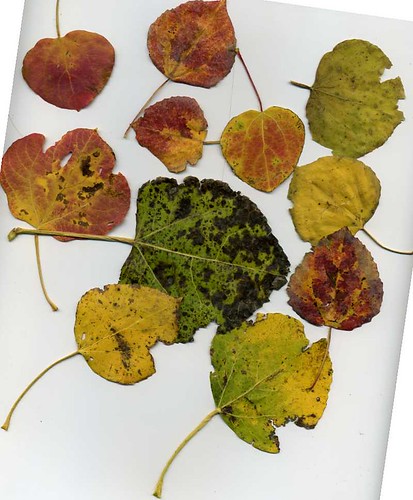
autumn leaves

Page 623-626 has activities to complete during each of the four seasons with your tree. I am anxious to apply these to the study of our tree that we are watching for a year. If you want to read about that study you can read these two blog entries on my main blog:
Tree study #1
Tree study #2

I am finding so much to learn about nature in my own area of the world.
Barb-Harmony Art Mom

True Bugs: Brown Marmorated Stink Bug


Here is a link to read more about this bug that we found in our kitchen. The photos are a little unclear since I took them through the top and bottom of the plastic magnifying container that we have for observation of bugs. You get the idea though of what he looks like. We think that he came in on some fruit or veggies or flowers from the garden and was a little lost inside the kitchen. We took him back outdoors when we were finished studying him.

Brown Marmorated Stink Bug


From page 297 of the Handbook of Nature Study:
"It must be remembered that while many people refer to all insects as bugs, the term bug is correctly applied only to one group of insects. This group includes such forms as stinkbugs, squash bugs, plant lice, and tree hoppers."

Barb-Harmony Art Mom

Tuesday, October 16, 2007

More on Daddy Longlegs


We had this daddy longlegs make his web** right on the outside of our window glass. We decided this was the perfect way to observe him as he moved around his web. We could get right up underneath him and look at his body parts. We had already learned that he is not an insect but we still thought he was an interesting subject for our nature study.

From page 434 of the
Handbook of Nature Study:
"In the North, all except one species die at the approach of winter; but not until after the female, which, by the way, ought to be called "granny longlegs." has laid her eggs in the ground, or under some protecting stone, or in some safe crevice of wood or bark."

"They get their growth like insects, by shedding their skins as fast as they outgrow them. It is interesting to study one of these cast skins with a lens. There it stands with a slit down its back, and with the skin of each leg absolutely perfect to the tiny claw! Again we marvel at these legs that seem so threadlike, and which have an outer covering that can be shed. "

I found one of these exoskeletons in the web of this daddy longlegs. It looked just like the daddy longlegs and I wondered how it slipped its slender legs out of that skin. I read on another website that the daddy longlegs will shed its skin every ten days. I also read that they can grow a new leg if one gets broken....amazing and fascinating.

Page 434:
"Put a grandfather greybeard (daddy longlegs) in a breeding cage or under a large tumbler, and let the pupils observe him at leisure. If you place a few drops of sweetened water at one side of the cage, the children will surely have an opportunity to see this amusing creature clean his legs."

The Handbook of Nature Study on page 434 also lists out eight activities you can do to observe the daddy longlegs. We are going to give a few of them a try the next time we have a daddy longlegs come to visit.

Here's my original post on daddy longlegs:
Daddy Longlegs: Not an Insect

**I have since been told that daddy longlegs don't construct webs. I did some additional research online to find the answer.
Here's another source that may clear up the mystery and I will just cut and paste from Wikipedia:

"The Pholcidae are a spider family in the suborder Araneomorphae.

Some species, especially Pholcus phalangioides, are commonly called daddy long-legs spider, daddy long-legger, granddaddy long-legs spider, cellar spider, vibrating spider, or house spider. Confusion often arises because the name "daddy longlegs" is also applied to two distantly related arthropod groups: the harvestmen (which are arachnids but not spiders), and crane flies (which are insects)."

Barb-Harmony Art Mom

Monday, October 15, 2007

Eagle Watching at Taylor Creek


Yesterday we took another shot at finding some eagles to watch. We have an eagle habitat about 45 minutes from our house, near a salmon spawning creek. We went up there a few weeks ago to watch the salmon and we thought we saw an eagle circling overhead, up over the pines. Of course we hadn't brought our binoculars along on that trip so we weren't sure if it was eagle.


The dead tree in the distance along with the green trees has a nest in the top. Click the photo to make it larger and then you will see in the tree that looks dead a sort of platform nest on the top of it. Eagles nests are huge when they are being used.

This time we went back with binoculars in hand to see if we could spot him again. We didn't. We did see a nest in the distance. We did see an snowy egret or egretta thula, some Canadian Geese, and several varieties of ducks.


This is really a hard photo to see the snowy egret but he is the white dot in the brown tree in the middle of the photo.....click the photo to make it larger. They are normally down by the water but this one kept flying up into the trees.


Spawning salmon-click the photo to make it larger and you will see the beautiful color of the spawning Kokanee salmon

Thousands of salmon all trying to get upstream to spawn...so colorful.


The highlight of the day was watching the Kokanee salmon spawning in Taylor Creek. There were hundreds and hundreds of these brightly colored salmon, all making there way up the creek to spawn and die at the end of their life cycle.

There was nothing in the Handbook of Nature Study about eagles...not a common bird for most. I will look further into the bird section of the book in the spring when we are focusing on birds.

Barb-Harmony Art Mom

Friday, October 12, 2007

Honeybee Study: Dead or Alive?


Yesterday the honeybees were still buzzing in the lavender in the front flower bed. I was wandering around looking for some insects and this worker bee let me take few photos while he did his gathering. This shows the eyes really well.


Here is a "behind" photo of the honeybee as he worked. I love the wings texture in this photo and I love to look at his legs...he is well equipped for his work isn't he? Check out the few little ants in the lavender blossom. I didn't notice them until I loaded the photos onto the computer. Amazing what life there is all around us that we don't notice until we focus.

From the Handbook of Nature Study page 394:
“In a colony of honeybees there are three different forms of bees, the queens, the drones, and the workers. All of these have their own special work to do for the community.”


All three bees appear differently and all three have different jobs. The bee we saw in our garden is the worker bee who does the actual gathering of the pollen.

Page 394 of the Handbook of Nature Study lists eight suggestions for observing the worker bee. I think it would be better to study a dead bee than to try to see all the intricate parts on the bee while it is working. The book suggests that in this case we should endeavor to find dead bees to look at with the hand lens or under the microscope at a low power.


From page 394:

“Although ordinarily we do not advocate the study of dead specimens, yet common sense surely has its place in nature study; and in the case of the honeybee, a closer study of the form of the insect than the living bee might see fit to permit is desirable.”


She says this sort of study is suitable for eighth grade work and not below that age.
I do have an acquaintance that has an aviary and I am going to ask him if he can provide us with a few bees to look at in our casual study of insects. We may even be able to talk him into giving us a field trip opportunity to his house to see his hives in action.

Barb

Harmony Art Mom

Thursday, October 11, 2007

Rain beetles: How to Identify a New Insect


Rain beetle: Although she looks dead, she really wasn't. She kept flipping over on her back and wiggling and stretching her legs.

Today was a first. I actually looked closely at a very ugly beetle. Yes, I am becoming an insect gal. I know this for sure because my daughter and her friend Shyloh brought me home a very large, very alive beetle creature. I had asked all my family to bring home any interesting insects they find and had even given them each a ziploc sandwich bag to bring them home in. Yesterday was the first time someone brought me an insect treasure. They said they couldn't bear to put it into a baggie so they used a small plastic container from my daughter's lunch box. She said there were hundreds of the beetles so she felt like she could bring one to us to study.

This photo shows her shiny covering and the hair on her underside.

At first I was disgusted by this creature but after taking her out of the container and looking carefully, I once again found the beauty in the design of the Creator. Now all that was left to do was to discover what sort of beetle this insect was.
Sequence:
1. I pulled out my field guide but could not see any beetles that looked like this one.

2.So it was off to the internet and we started by looking up "beetle, california" on Google. I am finding that if I Google something and then look at the images it takes me far less time to identify a creature.

3.Once you find an image that looks like your insect, click on the link associated with that image. The majority of the time this is enough to get you pointed in the right direction.

Here's what I learned about this little female insect: Rain beetle or P. puncticollis (more on classification at BugGuide.net) and can be found in California woodlands. The male is approximately 1" and the female can be slightly larger at 1 3/4". The males have wings but the females do not. They range in color from reddish-brown to black. The underside is covered in hairy bristles.

The interesting thing about this beetle is that it makes a sudden appearance after a soaking rain....hence the name Rain beetle. We had a really good rain all the night before so I think this is probably why we were able to see this amazing creature.

The life cycle of the Rain beetle is very long. The larvae, who feed on roots of live trees and bushes of oaks and conifers, take up to as much as 10-12 years to mature but once they become adults the males wait for the first rains to bring them out for their mating flight and the females dig a tunnel to the surface to wait for the males to find them. Here is the fascinating part:The conditions that trigger the males and females to emerge are so stringent that this may only happen in a population for a single day in a given year. This made the finding of this insect all the more precious since it is a rare event.


This is the head of the beetle and if you look closely you can see her little "horns".

The males fly slowly over the area, low to the ground, looking for the females who although rarely leave their underground burrow, wait at the burrow's entrance for the arrival of the males. She puts off a pheromone that attracts the males. After mating the female closes off the entrance to her burrow and lays her eggs. These mature the following spring.


I love this photo that shows her leg parts.


Wow, so much to learn. I have a new appreciation for the study of insects after learning that this was not just an ugly bug. It has a whole life story to learn and now I can share it with others.

Final thought from the Handbook of Nature Study, page 6:
"When it is properly taught, the child is unconscious of mental effort or that he is suffering the act of teaching."

I did all this research and it hardly felt like any effort at all. I will be striving to make our nature study so that it is interesting and feels not like work but like refreshment.

Barb-Harmony Art Mom